
Mária Orišková
Neither Saints nor Sinners: A Critical Analysis of the Visual Representation of Women in Modern Slovak Art History
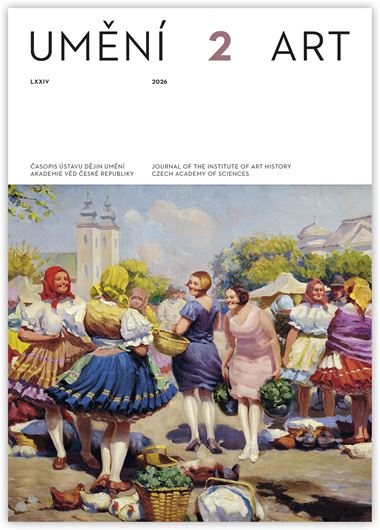
The primary aim of this study is to examine how gender stereotypes contribute to the formation and functioning of narratives that construct national identity. Gender identity and gender relations, long neglected in modern art history, must be understood as social norms of masculinity and femininity operating within existing hierarchies of power. As the French sociologist Pierre Bourdieu has argued, what is at stake is not only the naturalisation of sexual difference but, above all, the principle of androcentric unconsciousness regarding the participation of men and women in the historical structures of the universal order. In this case, the study focuses on the history of art in Slovakia during the First Czechoslovak Republic (1918–1938). It uncovers the androcentric unconscious embedded in Slovak art-historical structures through representations of women that not only naturalised but also legitimised relations of male dominance and female subordination, while simultaneously contributing to the creation of various myths, including those of art history itself. Set against these “male” artistic representations of rural women is the concept of the new, emancipated woman, which emerged in the course of modernisation and the development of urban life in Slovakia. Accordingly, the study also addresses social distinctions, particularly the stereotyping of rural and urban women, which functioned in accordance with the emerging “national” art-historical canon. Whereas Slovak artists typically portrayed rural women in an idealised manner, attributing to them almost exclusively positive qualities (for example, the Slovak Madonna as mother transformed into saint), urban settings gave rise to images of women as immoral or sinful, functioning as a mirror image of the idealised, morally “pure” village woman (or humble woman of the people). The contrast between the “saint” and the “sinner”, as a form of binary opposition, nevertheless represents only a simplification of the issue in the service of an unwritten moral code. It may therefore be concluded that artists and theorists, as active creators and dominant observers of both environments, long contributed to the construction of myths about women and “true” or “proper” femininity. In the recent work of women artists, however, one finds an explicit critique of binary modes of thought and of such stereotypes.
Author's email:
maria.oriskova@truni.sk
DOI: https://doi.org/10.54759/ART-2026-0202
Full-text in the Digital Library of the Czech Academy of Sciences:
https://kramerius.lib.cas.cz/uuid/uuid:d038d4c0-7776-46c4-9586-f03eef95458c
< back